In the last 25 years the name of Burtonwood has been carried by thousands of American servicemen to countries all over the world. It is the only place in the British Isles to bear this name, and is possibly more widely known than Warrington, to which it was originally a subservient manor.
THE WOOD BY THE TUN’
Probably the original name of Burtonwood was simply ‘Burton’, which means the ‘tun’, or farmstead, by a ‘burh’, or fortified manor. The burh could have been the borough of Warrington. The wood, however, was a real and extensive royal forest early in the 13th century, and the name had become Burtonwood by this time. The addition of ‘wood’ to ‘Burton’ therefore gives the full meaning of Burtonwood as the wood by the tun, or farmstead, near a fortified place, or burh.
The registers of Burtonwood have been published for the years 1668-1837 but do not contain any individual named Burtonwood. The only person of this name to appear in local records was John Burtonwood, who was described in 1622 as ‘lecturer’ at St Helens Chapel.
LORDS OF THE MANOR
The earliest mention of Burtonwood occurs in a Charter of King John dated 10th October 1199, whereby the town of Pendleton was granted to Yarforth de Hulton in exchange for Burtonwood and Kersall Wood, which John had given to him while he was Count of Mortain. Henry I placed Burtonwood in his forest between Ribble and Mersey, and in 1228 it was perambulated in accordance with the Charter of the Forest of 1224-25.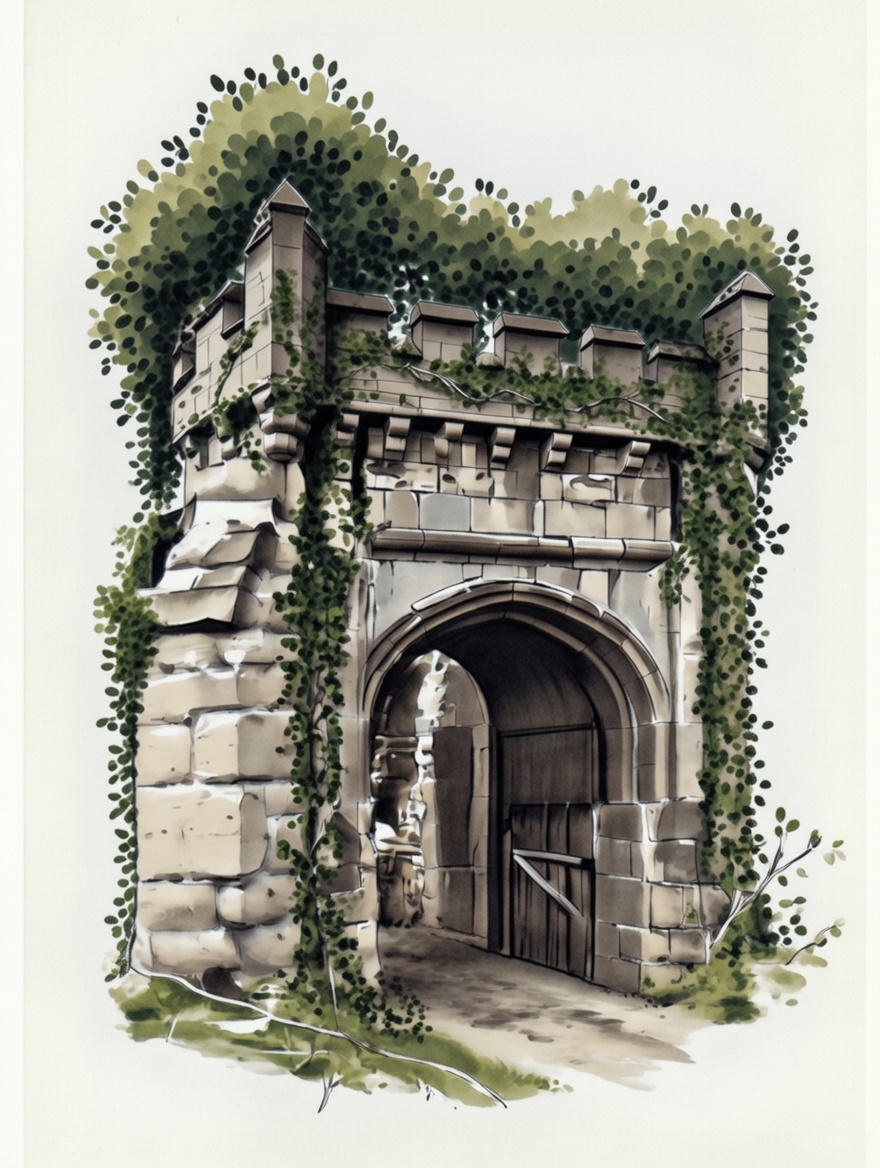
All that remains of the entrance to Bradleigh Hall – once the Manor House of Burtonwood – with the original cobbles still visible.
The Manor was sold to William Boteler, seventh Lord of the Manor of Warrington, in about 1264, and the Boteler family then settled at Bewsey in Burtonwood until the last of the Botelers, Edward, alienated the Manor to Richard Bold in 1580.
THE COMMUNITY GROWS
Although the small community of Burtonwood depended for centuries on agriculture, it is noticeable from the registers that other trades, especially watchmaking, begin to form a moderate proportion of the trades and skills supporting the inhabitants of the Parish in the 18th century.
Records of 1924 state: ‘The soil is clayey and the chief crops are wheat, oats, potatoes, grass and clover. The area is 4,195 acres, 33 of which are under water. The rateable value is £19,776 and the population in 1921 was 2,383.’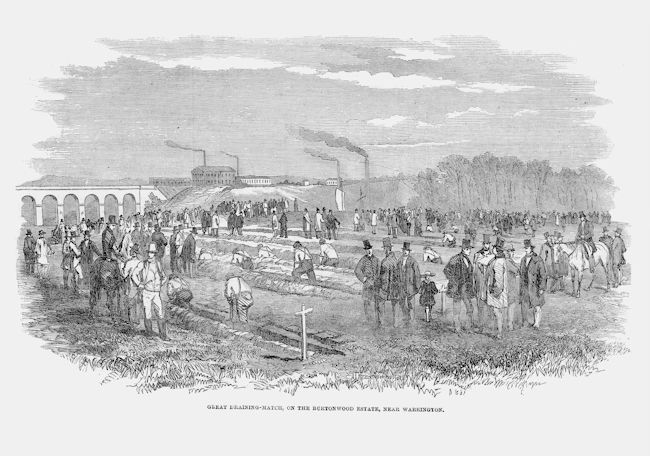
Scene of the Great Draining Match in 1853 on the Burtonwood Estate, with the chimneys of nearby Newton-le-Willows in the background. Courtesy of Warrington Reference Library.
But that comment was made exactly 51 years ago, and Burtonwood has seen many, many changes since then. Its rateable value in 1974 was £401,171 and the population has risen to just over 5,000.
The Americans who manned the great air base during the war left in June 1959, but came back again, although in less great numbers, in 1967 – providing numerous jobs for civilians.
The kindness and generosity shown to them in the dark war years by Burtonwood people still abounds, and the village pubs – The Bridge and The Elm Tree Inns – echo once again to the trans-Atlantic twang of the servicemen.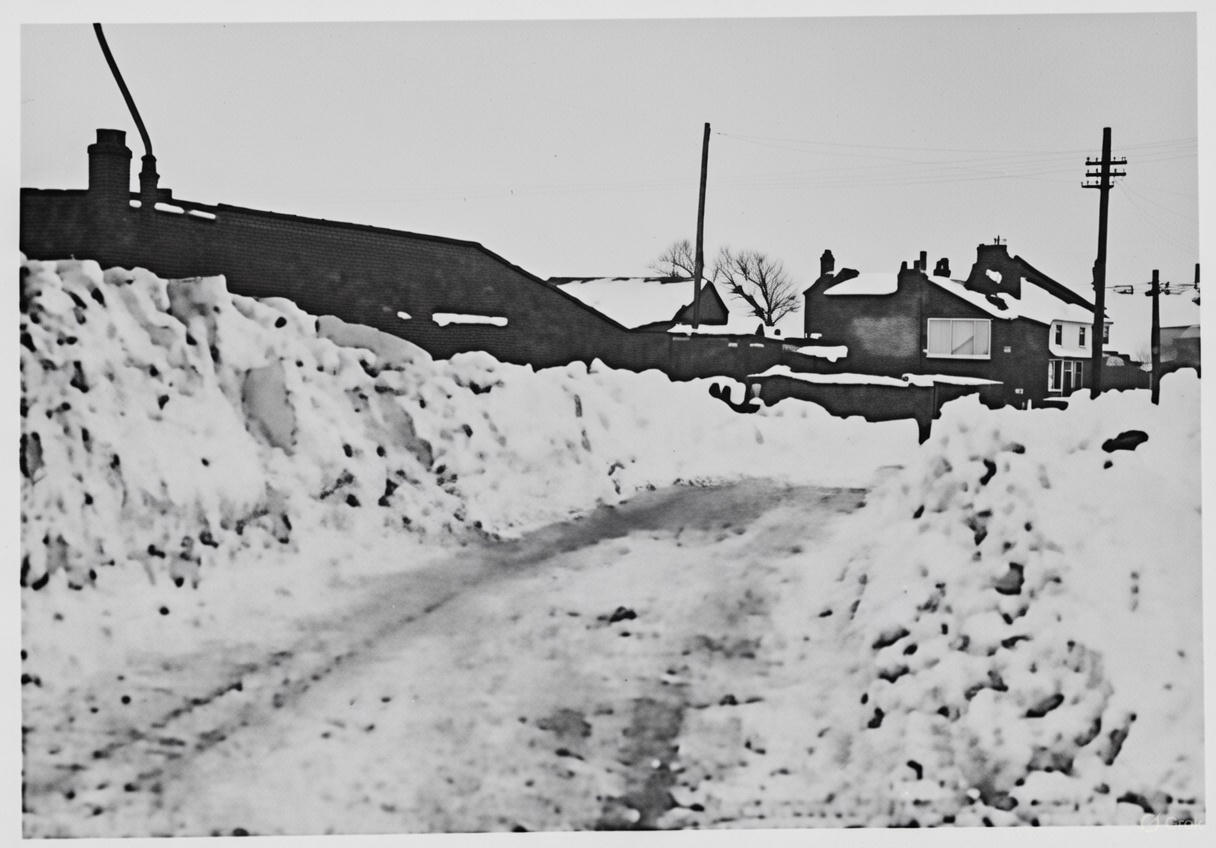
The snow fell thick and fast in the 1940’s. This scene is of Chapel Lane looking towards the Elm Tree Inn.
BURTONWOOD TODAY
A contributory factor to Burtonwood’s expansion was the designation of Warrington as a New Town in 1968, with the acceptance of an Outline Plan in 1973.
While retaining its mainly village atmosphere, Burtonwood lends itself to increasing popularity as a residential area by the very nature of its geographical position. Residents can enjoy the delights of living in a rural environment and yet still be within easy commuting distance of the neighbouring industrial towns. And, with an ever-expanding population, the village has developed architecturally to cope with the demands for leisure and education within the community.
Burtonwood now has two junior schools, a County Primary in Green Lane and St Paul of the Cross Roman Catholic Primary in Clay Lane. The older children attend secondary schools in Newton-le-Willows and St Helens. The main sources of employment in the area are in the nursing, engineering and brewing industries.
The new St Paul of the Cross Roman Catholic Church in Mercer opened in 1972, and opposite St Michael’s Church in Chapel Lane stands the village library. The village also boasts a sparkling Community Centre. Social clubs, church organisations and youth movements provide additional activities, meeting places, and a forum for local discussion.
The village – although one of many contrasts – has managed to retain some of its old customs, which at one stage were in grave danger of dying out. And although the crowning of the Dahlia Queen – a great village event in years gone by – no longer takes place, its place in the calendar has been taken by the annual Burtonwood Carnival. This itself was ‘resurrected’ in 1973 after an absence of six years, and now proves to be a real crowd-puller.
On the local government front, Burtonwood is administered by Warrington Borough Council and, although it has its own Parish Council, two representatives serve on the Warrington Council, to keep an eye on matters which might affect the village.
A far cry indeed from the year 1199, when King John ruled with an iron fist and Burtonwood was just a tiny hamlet nestling in his vast hunting forest!
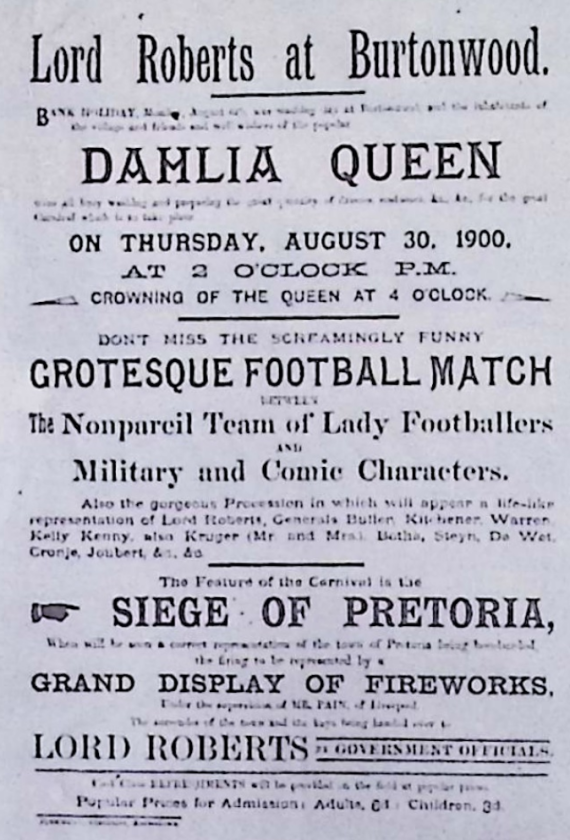
One of the big events in village life many years ago – the crowning of the Dahlia Queen. This poster, dated 1900, was on file at Warrington Reference Library.
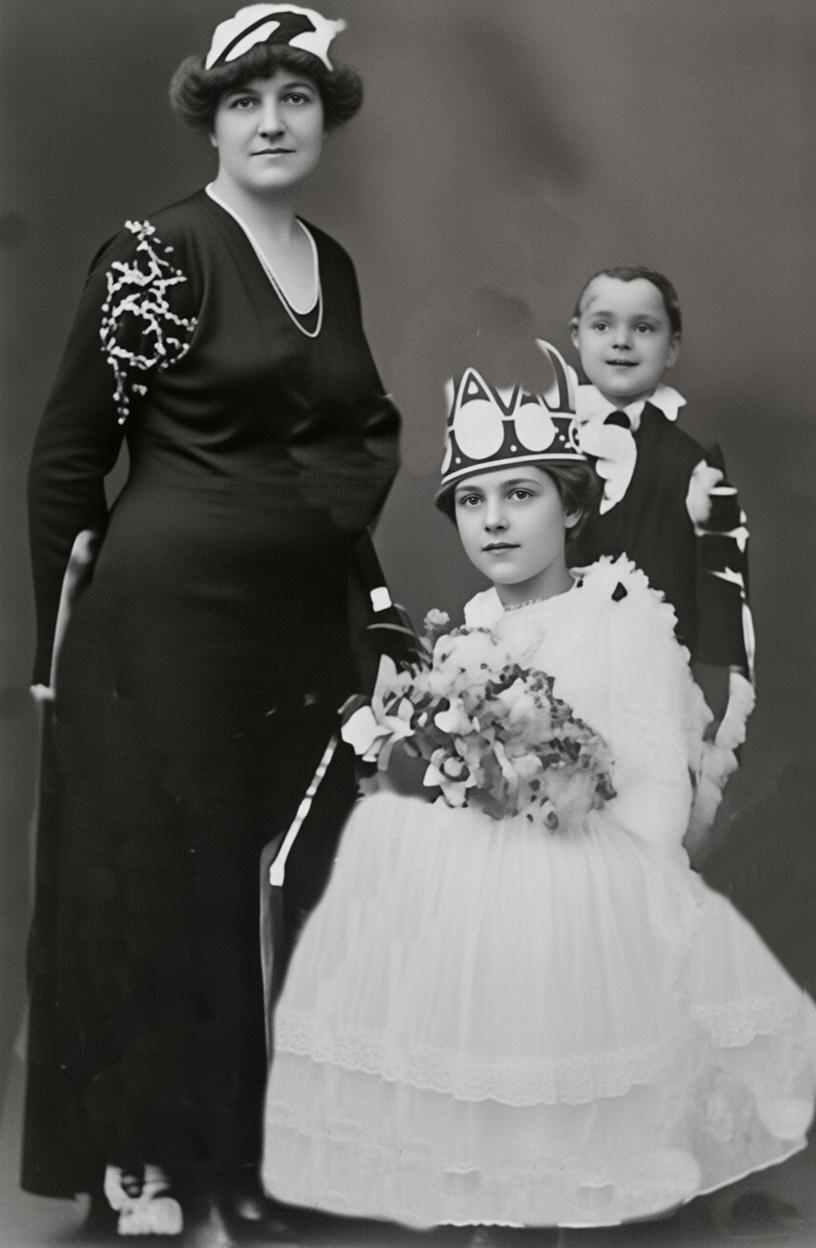
Crowning of the village Dahlia Queen. Date unknown.
Schooldays remembered! Date unknown, probably of the village school in the early 1900’s, but it should jog a few memories.
THE CHAPEL
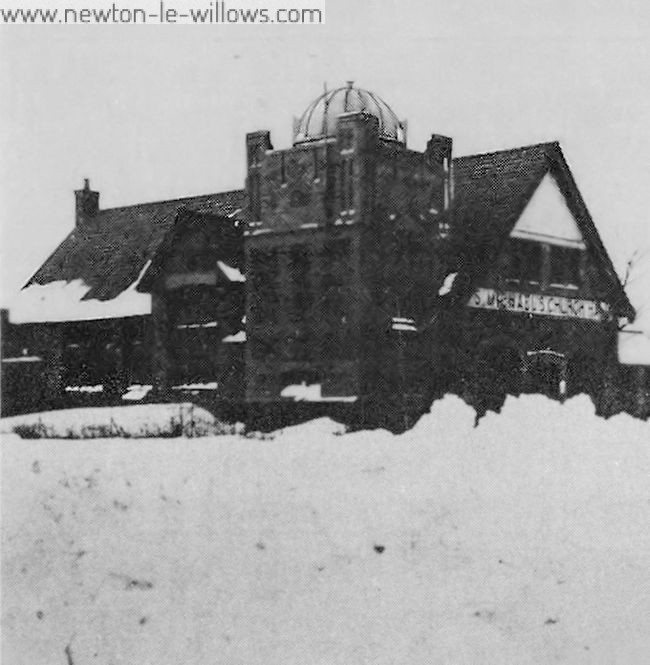
The old St Michael’s Church Hall – now demolished – which stood in Green Lane.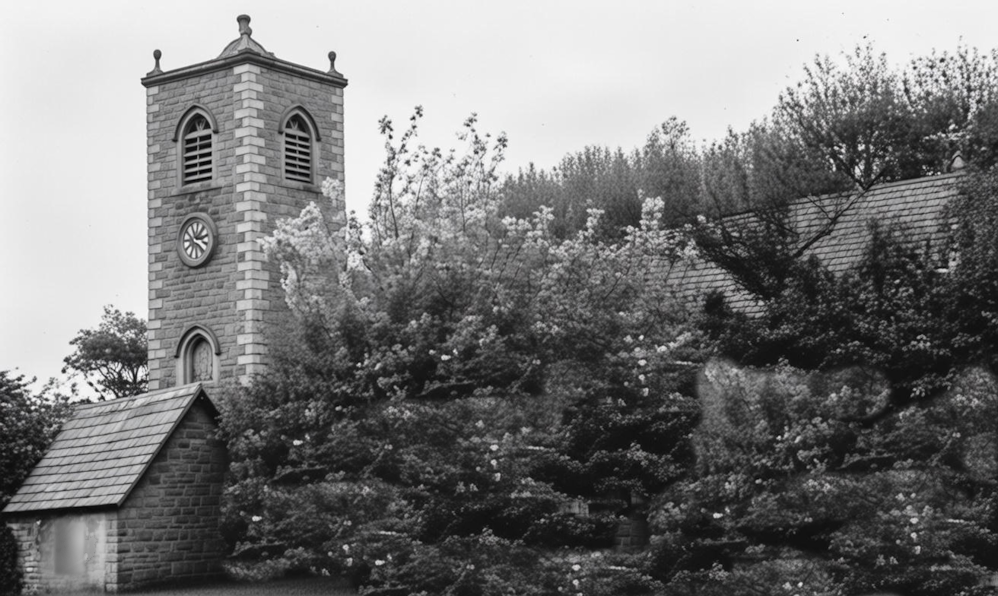
St. Michael’s Church 1975.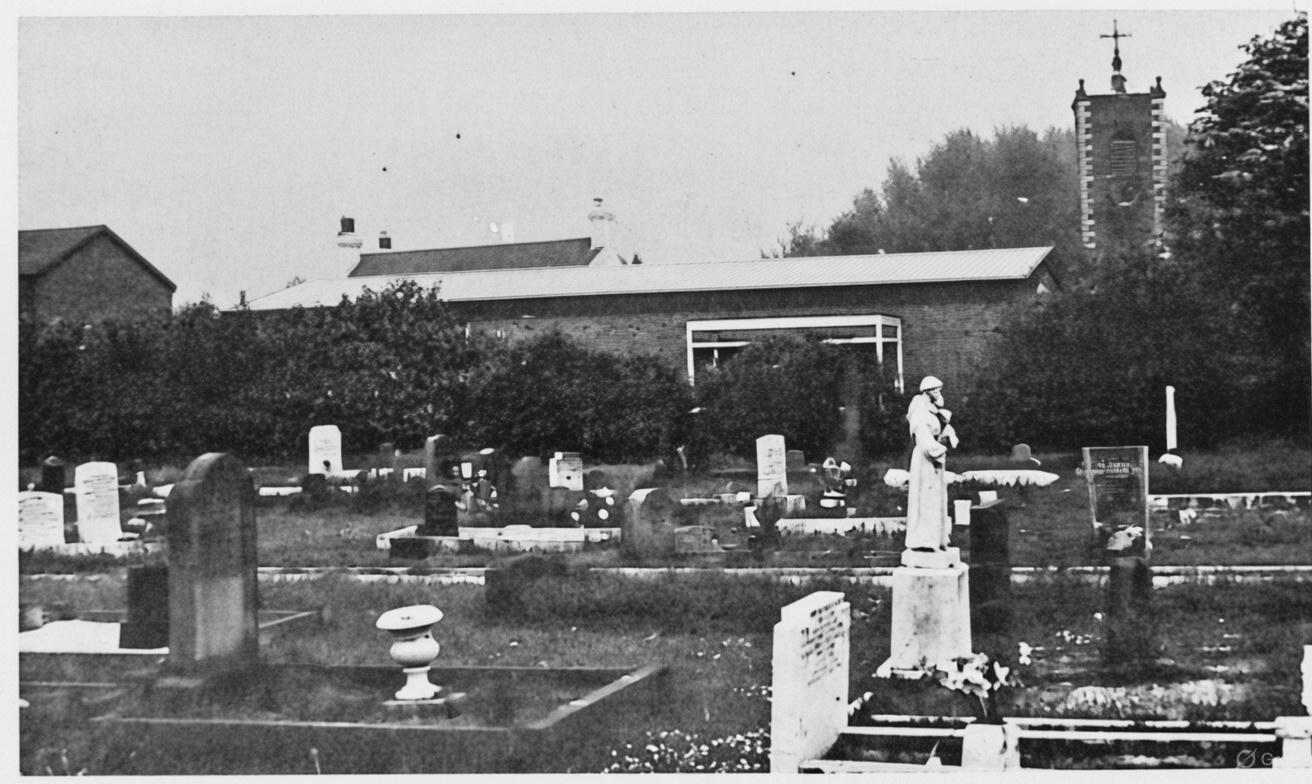
Old and new – the graveyard, the village library and the tower of St Michaels in the background.
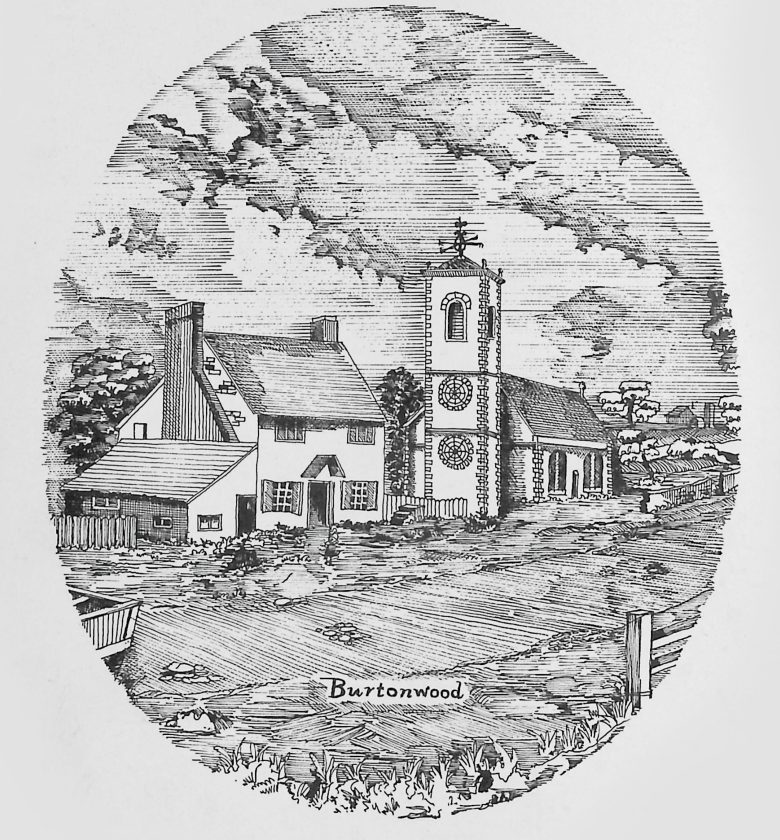
The Chapel of Burtonwood was founded by Sir Thomas de Bold in 1605, when Burtonwood was part of the Parish of Warrington. It was consecrated by the Rt Rev John Lord, Bishop of Chester, on 16th December 1634 in the presence of Richard Bold and Thomas Ireland of Bewsey.
During the Commonwealth, Burtonwood became a separate Parish, and it must have excited many of the Americans who came to Burtonwood in World War II to discover that an early incumbent of the Church, the Rev. Samuel Mather, had sailed to America in 1635 with his father, the Rev. Richard Mather, to join the Pilgrim Fathers. Samuel returned to this country and became Vicar of Burtonwood – and probably the first American in the village!
RESTORATION AND RENEWAL
The present building was erected in about 1716. Some of the old oak beams of the former original Chapel were incorporated in the gallery of the Church, but because of decay the gallery was taken down in 1939 – when the entire building was restored and enlarged.
By 1893 the Church was considered too small and unsafe, and efforts were made – without success – to collect £1,000 towards the cost of £8,000 to build a new church in Green Lane, Burtonwood. The top of the old tower was taken down in 1932.
In 1936 the Rev. Thomas Cowing closed the Church and held services in the Church Hall. A sum of more than £1,000 was collected towards the cost of restoration, and the old Church, which had stood for so long on the same site, was restored at a cost of £4,390. (A lot of this money was donated by Joan Forshaw). The south wall was taken down and a new aisle added. A new tower was built, in which an ancient bell and clock were placed. A new baptistry, choir and priest vestries were added in the west wing, and the interior was refurnished in selected oak, with a new altar, choir screen, pulpit, lectern and pews.
An organ – the gift of St Michael’s, Blundellsands – was also installed. New stained-glass windows were put in on the north and south sides of the Church, and on these are shown the crests of notable families connected with Burtonwood in the past.
The Church was reopened and consecrated on 30th September 1939, in the reign of George VI, by the Rt Rev H Gresford-Jones, Suffragan Bishop of Warrington. In 1966, as a result of mining subsidence, extensive repairs to the Church were carried out, including the complete redecoration of the interior.
COMMUNITY AND CHURCH
Before 1784, no records were kept of burials within the Parish. One headstone at the Church bears the date 1777, but there are others, much older, which are too weathered to be deciphered.
A cemetery of two acres was formed in 1900 under the control of the Parish Council, Lord Lilford, Lieut. Col. Charles Lyon J.P. (who was Lord of the Manor) and Richard Evans & Co of Haydock (the chief landowners).
A Roman Catholic Church, dedicated to St Paul of the Cross, was erected in Burtonwood in 1886, and a Wesleyan Chapel was built in 1907.
Records of 1924 show that the net yearly value of the Vicarage was £294. A new and smaller Vicarage was erected in 1964 on the same site where the Vicars of Burtonwood had lived from the early 17th century.
After it was decided that the old Parish Hall in Green Lane – now demolished – was too large and too isolated to serve the Parish well, work began in 1971 on a new £13,000 Church Hall, which now proudly stands off Chapel Lane.
BREWING BEGAN 1867
On March 13th, 1867, James and Jane Forshaw purchased the land on which the Burtonwood Brewery now stands.
James had some brewing training while employed at the Bath Springs Brewery, Ormskirk, and probably chose the site because of its position mid-way between Warrington and St Helens, and also because there was an adequate supply of suitable water readily available.
The first brewery had a 14-barrel open-fired copper, two 12-barrel Fermenting Vessels and a cellar capacity for 45 barrels. The trade was with Free Houses, farmers and private landowners, mainly in small 4½ gallon casks known as ‘Tommy Thumpers’.
THE FIRST PUBLIC HOUSES
In 1870 Richard Forshaw came to live with his aunt and uncle, following the death of his mother, and in 1874 they purchased their first freehold Public House, and had leases on eight other houses. They were then selling about 20 barrels a week at 30s a barrel.
In 1880 James died and the business was carried on by Richard and his aunt. They increased the number of houses owned by the Brewery, and in 1884 they were doing 40 barrels a week.
Richard took up farming in 1885 but in 1890 – helped by a small legacy from his father – he purchased the Brewery from his aunt on the occasion of her second marriage, to the Rev. Wilson, vicar of Burtonwood.
Richard married Alice Kershaw in 1887 and they were survived by four children – Tom, Mary, James and Richard.
During the miners’ strike of 1893 there was much local depression, and Richard provided free bread, potatoes and beer for the miners’ families.
In 1894 William Singleton joined the company as a brewer and, except for short intervals, he and his son Harold were the Head Brewers of the company until Harold’s death in 1964.
BOTTLING AWARD
Bottling commenced in 1895 and, in the following year, the company won the highest award at the Brewers Exhibition for its Bottled Stout.
In 1898 Jane Wilson died – by which time 60 barrels a week were being averaged.
In 1904 the company started supplying Workingmen’s Clubs in the local areas of St Helens, Haydock, Earlestown and Warrington – the foundation of the large Club trade enjoyed today – and by 1907, when Tom Forshaw started work in the Brewery, the trade was 200 barrels a week.
By 1912, Mary Forshaw was the Company Secretary and had started driving for her father. This duty increased when he was injured in the Ditton rail crash during that year.
AFTER THE GREAT WAR
James and Richard served in the army during World War I, as did John Gilchrist, whom Mary married in 1919.
In that same year, the company’s employees first went to ‘The National’ – an outing which has continued until the present day.
During and after the War, Richard Snr. and his elder son, Tom, continued to expand the business of the Brewery in Lancashire and Cheshire, while his younger son, Richard Dutton-Forshaw, founded the Burtonwood Engineering Company in 1922.
After Richard Snr. died in 1930, Tom Forshaw continued the expansion into North Wales, assisted by Richard Jackson, who served the company for 40 years.
EXPANSION AND DEVELOPMENT
In 1937 the Brewery was substantially rebuilt, and by 1939 it owned 138 freehold and 96 leasehold houses. Despite the restrictions of World War II, the business continued to develop, and early in 1945, 51 houses were acquired when the Caergwrle Brewery Company near Wrexham, North Wales, was purchased.
In 1946 Commander R. I. Gilchrist – the son of Mary Gilchrist – joined the company after war service in the Royal Navy, and in 1949 the company was renamed Burtonwood Brewery Co. (Forshaws) Ltd, following a reorganisation of the family holdings.
To facilitate expansion, the Brewery became a public company in 1964 and continues under the direction of the Forshaw family, controlling 300 houses in Lancashire, Cheshire, Staffordshire and North Wales, in addition to a similar number of club trade customers.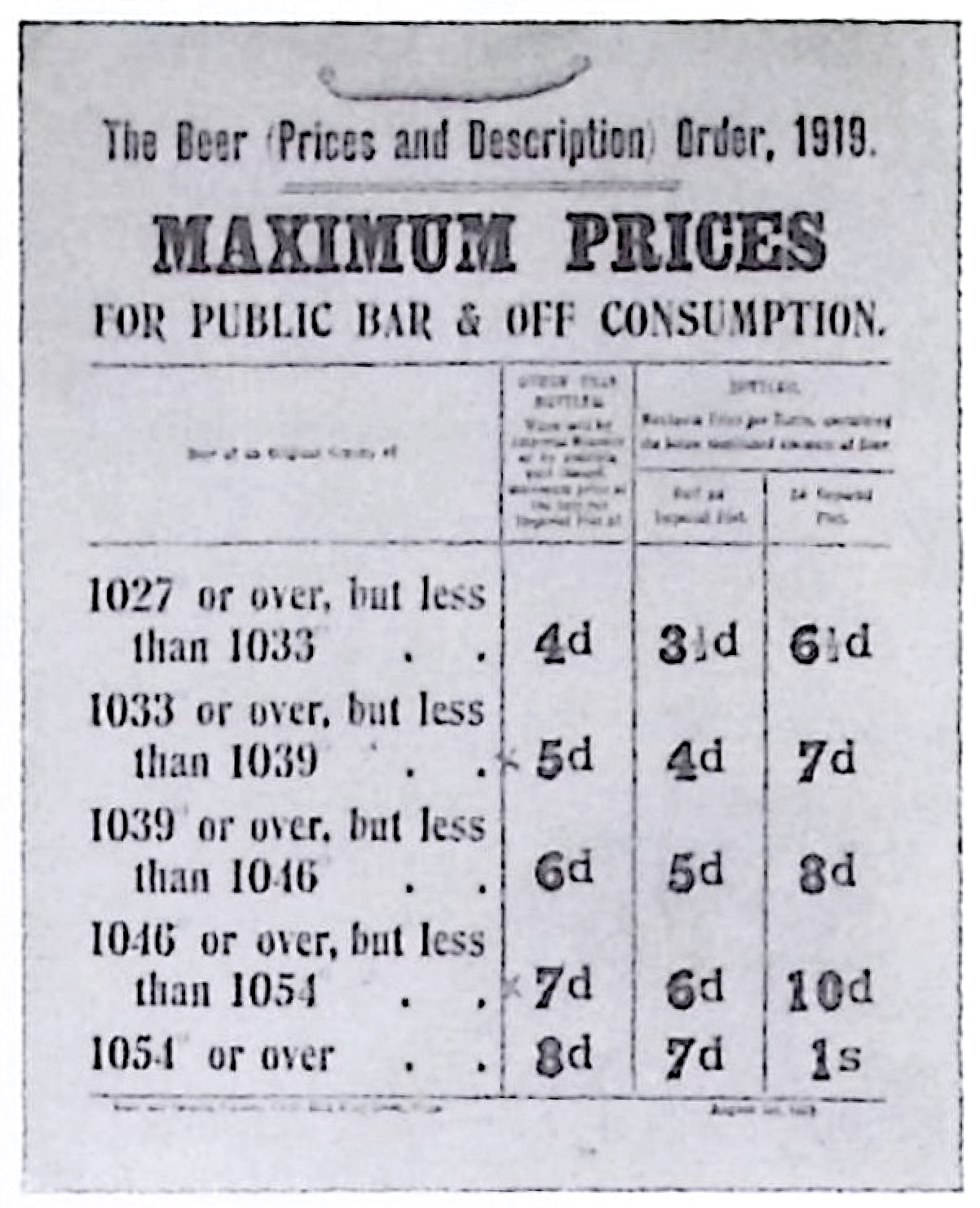
An auction by Messrs Thomas Winstanley and Sons at the Leigh Arms, Newton-le-Willows, in September 1839 offered for sale ‘Valuable and extensive freehold estates and coal mines in the Burtonwood and surrounding area.’
Rent for one George Gleave in July 1888 for ‘farm and land in Burtonwood’ was £156 19s 4d. The ‘house, garden and cottage’ cost him £5 a year and the ‘interest on buildings’ £9 14s 9d.
James Cooper had to pay 14s each September for the rent of pews in Burtonwood Chapel, records of 1850 show. And in 1887, Richard Pennington was charged £30 each September for ‘shooting over the Burtonwood estate.’
‘EXCELSIOR’
The Parish Magazine ‘Excelsior’ could be obtained for just one penny in the 1920s, when the Rev. A M Mitchell was vicar, and the Church was open from 7.30 am to 7 pm with ‘all seats free, no pew monopoly and free-will offering only.’
The June edition carried the following invitation to parishioners:
‘We gather some would like to use our pages for discussion. They will be at liberty to do so on passing the censor. The charge will be 1s 6d a line with a minimum of 10s 6d.’
THE STATE OF THE ROADS
The state of the roads in the village came under the spotlight for discussion in next month’s edition of ‘Excelsior’:
‘No one having to travel on foot or by wheel on our Burtonwood roads need think of purgatory as distant in time or in space. It is their portion here and on the spot. Punctured tyres and tortured, poor sore feet are purgatorial experience sufficient to the day of any traveller. Chips on one’s plate – of the potato order – are grateful to the palate and satisfying to the appetite, but ‘chips’ on the roads – hard, sharp angular stone chips – make the corns and bunions scream with pain.’
‘Chips – spare our roads and spare our feet. Bring out the steam roller to crush, grind and level off chips! You have too many which is our experience. Our roads here in Burtonwood bear a strong resemblance to patchwork!’
DURING THE STRIKE
During the first week of the miners’ strike of the ’20s, potato fields and hen roosts in the village were raided time after time by the strikers to gain food for their hungry families.
‘The club room at the Church was thrown open to our workers at play during the strike,’ the magazine reported.
‘Papers, daily and weekly, were provided, and a bright fire burned in the grate. Smoking was allowed, in moderation. The only rules were that all visitors must remember to be gentlemen, avoid roughness and protect the hall and its property from injury.’